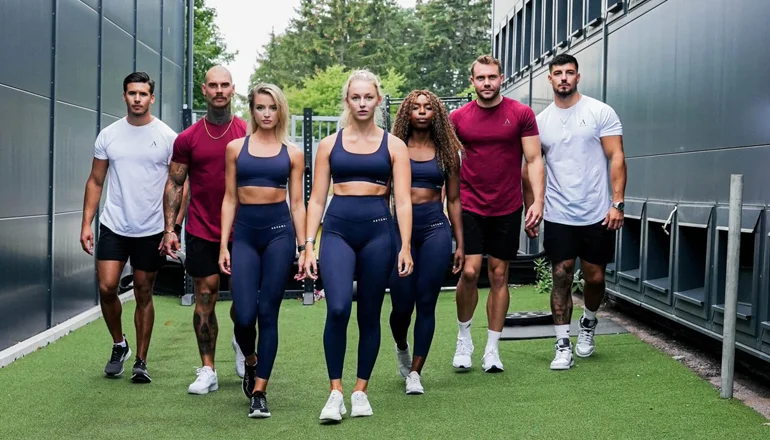










Every Astani garment is OEKO-TEX Standard 100 certified — tested against the global benchmark for harmful substances and made safe for skin contact during long, sweat-heavy training.
When you train hard, your clothes spend hours against your skin. Sweat opens pores. Heat increases what your skin absorbs. The OEKO-TEX Standard 100 mark on every Astani piece means an independent institute has tested the finished garment — fabric, threads, prints, even the zippers — against limits tighter than European law requires, so you can lift, run, and stretch without thinking about what’s touching your skin.
What OEKO-TEX Standard 100 means
OEKO-TEX is an independent network of textile testing institutes founded in 1992. Standard 100 is their globally recognised certification for textiles tested for harmful substances. To carry the mark, a finished garment — not just the raw fabric — must pass laboratory testing on every component that touches skin: the main fabric, sewing threads, dyes, prints, elastics, zippers, and buttons.
The certification is renewed annually. A product certified five years ago does not stay certified by default — it has to pass the tests every year, against criteria that themselves get stricter over time. This is third-party verification, not a manufacturer’s claim.
What gets tested
Standard 100 screens for more than 1,000 individual harmful substances. The list covers heavy metals (lead, cadmium, nickel that leaches into sweat), pesticide residues, formaldehyde, chlorinated phenols, allergenic and azo dyes, plasticisers like phthalates, and PFAS-class water repellents.
Limits are set tighter than European REACH regulation requires. They are also tighter for garments in direct skin contact than for items like curtains — because the more skin contact, the more dermal absorption matters.
Why this matters for activewear
Most clothing certifications exist for everyday wear: occasional contact, dry conditions, normal body temperature. Activewear sits in a different category — and Standard 100 is specifically designed for it.
- Hours of direct skin contact — gym tights, shorts, tees, and hoodies sit against skin for entire training sessions, not minutes
- Sweat opens pores — increases dermal absorption of anything in the fabric
- Heat speeds it up — body temperature during training accelerates how much you take in
- Frequency adds up — training 3–5× per week means more exposure than everyday wear
If you have sensitive skin, train daily, are pregnant or postpartum, or just want to know what’s touching your skin during your strongest hours of the day, the certification matters.
Astani’s certification scope
Standard 100 certification applies across the Astani garment range — every fabric blend, every color, every size. The certification is held on the finished garment, not just the raw cloth, so trims, zippers, drawstrings, and embroidery are all in scope.
The blends we test and certify include:
- 75% Nylon, 25% Spandex — used in DIVINE Wide Flared Tights and SLEEK Zip Jackets
- 90% Nylon, 10% Spandex (250 gsm) — used in BLISS Scrunch Tights and BLISS Scrunch Shorts
- 95% Cotton, 5% Spandex (165 gsm) — used in CODE T-Shirts
- 95% Cotton, 5% Spandex (330 gsm heavyweight) — used in APEX Zip Hoodies
We re-certify annually. Every collection drop is tested before the line goes to inventory.
Where to find OEKO-TEX certified styles
Every Astani product page carries the OEKO-TEX Standard 100 line in its What makes it different section and Material & Care block. Browse the certified range by category:
- Women’s flared tights — DIVINE Wide Flared family
- Women’s scrunch tights — BLISS + SENSE Scrunch families
- Women’s seamless tights — EVE + BLISS + SENSE families
- Women’s high-waisted tights — BLISS, DIVINE, EVE, AURA, PEAK families
- Women’s shorts — BLISS Scrunch Shorts family
- Women’s jackets — SLEEK Zip Jacket family
- Women’s padel clothing — PEAK Tights, TRIUMPH Crops, and tops
- Women’s CrossFit clothing — PEAK Tights, TRIUMPH Crops, and tops
- Men’s t-shirts — CODE family in dark green, orange, and more
- Men’s hoodies — APEX Zip Hoodie family
- Men’s padel clothing — FORZA Tees, VELOCE Shorts, accessories
- Men’s CrossFit clothing — FORZA Tees, VELOCE Shorts, accessories
Free shipping over €70. 30-day returns. OEKO-TEX Standard 100 across every piece.